April 10, 2026Opinion
Knowledge Graph vs Semantic Layer vs SQL/PGQ: The 2026 Enterprise Architecture Guide for AI Agents
Three different things are sold under one name. A full materialised knowledge graph, a semantic layer with a virtual ABox over your existing systems, and a thin SQL/PGQ wrapper that makes a relational database behave like a graph are not interchangeable — they differ wildly in cost, lock-in, and time-to-value, and vendors blur the line on purpose. Agents reset the stakes: a thin wrapper alone gives an agent structure without meaning, and an agent acting on the wrong definition of “Customer” is a remediation incident, not a meeting-room debate. So the semantic layer becomes the minimum grounding layer for any agent of consequence, a full graph earns its cost only where relationships are the product or agent memory needs structure, and the real deliverable is a deliberate hybrid. The discipline that decides success is unglamorous: don't buy the ontology before you hire the ontologist, and don't ship the agent before you buy the ontology.
§ 01
Frame
Every enterprise that wants AI agents, semantic search, or trustworthy LLM grounding eventually hits the same question:
Do we build a knowledge graph, sit a semantic layer on top of what we already have, or just teach our existing databases to behave like a graph?
Vendors blur this on purpose. The three approaches solve overlapping problems but at radically different cost, lock-in, and time-to-value.
Two things have changed the answer in 2026:
- Agents have become the dominant load profile. The question is no longer "how do my analysts query connected data?" but "how do my agents stay grounded, remember what they did, and not act on the wrong definition of Customer?"
- No serious enterprise will end up with a single methodology. The real architecture is a deliberate split — different domains at different levels, connected by a shared semantic spine.
This piece pulls the three methodologies apart, shows how agents change the calculus, maps the 2026 vendor landscape, lays out the hybrid patterns that actually work, and gives an honest verdict on when each one fails.
§ 02
The three methodologies, defined precisely
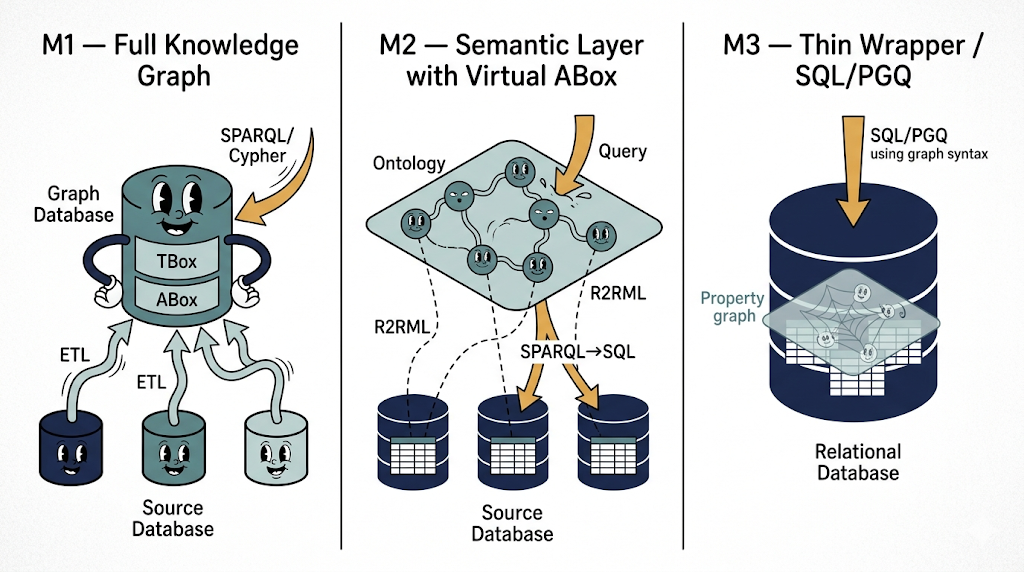
Methodology 1 — Full Knowledge Graph (materialised TBox + ABox)
A dedicated graph store (RDF triple store or property graph) holds both the schema (the ontology / TBox) and the instance data (the ABox). Data is physically extracted from source systems via ETL or CDC pipelines, transformed into triples or nodes/edges, and persisted in the graph. Queries run in SPARQL, Cypher, or GQL against the graph itself. Reasoners can materialise inferred triples.
Mental model: the graph IS the system of record for relationships and meaning.
Methodology 2 — Semantic + Ontology Layer with ABox Stubs Pointing to Existing DB Tables/Fields (Virtual Knowledge Graph / OBDA)
The ontology (TBox) is modelled formally — classes, relationships, constraints. But the ABox is virtual: instead of materialising triples, you write mappings (typically R2RML or Ontop-style) that say "the class Customer is populated by SELECT id, name FROM crm.customers, the relation placedOrder is the join customers.id = orders.customer_id." When someone queries the graph in SPARQL, the engine rewrites that query into SQL against the source databases and assembles the result at query-time.
Mental model: the source databases stay where they are; the graph is a query-time projection driven by a real ontology.
Methodology 3 — Thinner Wrapper: Make the Existing Database Function Like a Graph and Queryable Through Graph Mechanisms
No separate ontology. No materialised graph. Instead, the existing relational database is taught to expose a graph view of itself — typically via the new SQL:2023 SQL/PGQ standard (CREATE PROPERTY GRAPH … OVER … VERTEX TABLES … EDGE TABLES …), or via a translation layer that turns Cypher or Gremlin into SQL.
The graph is a view, not a store. There is light or no ontology — just labels, vertex/edge tables, and join keys. Queries get the graph pattern-matching operators (GRAPH_TABLE, variable-length paths, shortest-path) but execute as SQL plans on the underlying tables.
Mental model: your existing database is the graph; nothing moves; queries gain a new shape.
§ 03
The agent reality check (read this before anything else)
If you are evaluating any of this for an enterprise that has agents on its roadmap — copilots, customer-facing assistants, investigative agents, operational orchestration — the analysis above is necessary but not sufficient. Agents change the load profile in ways that make M3-only look much riskier than it first appears, and make M2 + M1 design choices into runtime safety decisions.
What an agent actually needs at runtime (the "context graph")
An AI agent at runtime needs four things stitched together:
- Identity and memory of the conversation/task — who the user is, what they have asked before, what the agent has already done.
- Working state of the current task — open tickets, draft outputs, pending tool calls.
- A grounded view of the enterprise — what a "Customer," "Order," "Account," "Policy," or "Incident" is in this company, and how those entities connect.
- A retrieval channel into the data — the ability to pull specific records that are relevant to the task.
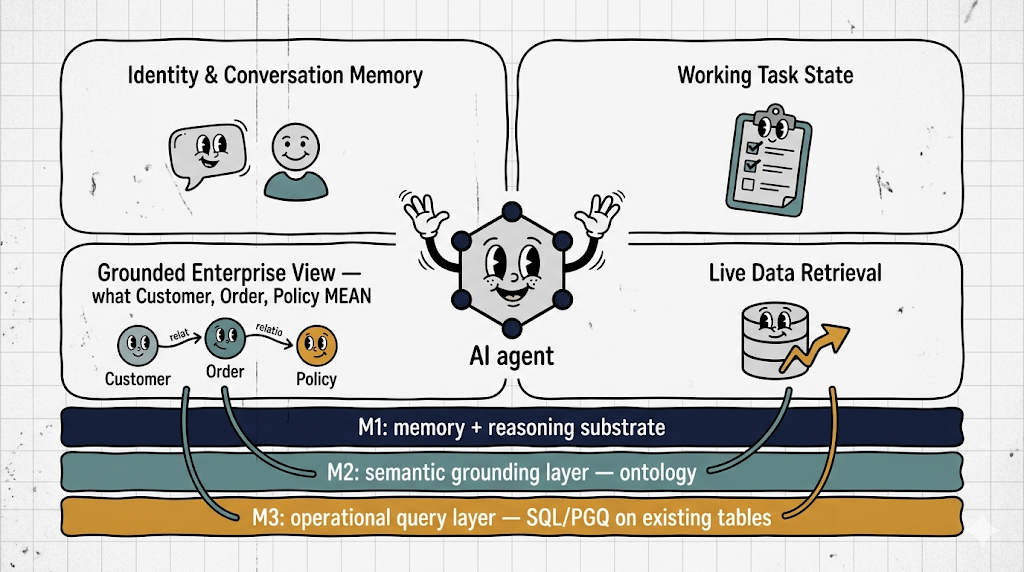
The first two are agent memory (working, episodic, semantic). The third and fourth together are what vendors are now calling a context graph — the graph-shaped layer that gives an agent a structured map of the enterprise it can navigate, traverse, and ground against, rather than a soup of vector chunks.
This is the layer Neo4j is building agent-memory + Context Graph products for, that Palantir's Ontology MCP is exposing to external agents, that Stardog Voicebox is consuming under the hood, and that Microsoft's Agent Framework is connecting to via Neo4j providers.
How agents change each methodology's role
M3 alone becomes brittle for agents. A property-graph view over a relational database gives agents structure — they can traverse foreign keys, find shortest paths, do pattern matching. But it gives them no meaning. An agent asked "show me customers at risk" will fail because the M3 layer doesn't know what "at risk" means, what counts as a customer, or how risk is computed across product lines.
Agents amplify the cost of missing meaning. A BI dashboard with a wrong "Customer" definition is a meeting-room debate; an agent acting autonomously on a wrong "Customer" definition is a remediation incident, a customer-experience failure, or a regulator letter.
M2 becomes the minimum viable agent grounding layer. Virtual knowledge graphs are where the agent grounding story actually fits well in 2026:
- The ontology gives the agent stable concepts (Customer, Order, Policy, Risk Tier) that survive schema changes underneath.
- The mappings give the agent live, query-time access to the operational truth, not a stale graph rebuild.
- The semantic constraints can be used by the agent to refuse unsafe actions ("you cannot mark an Order as Shipped without a SignedManifest").
- Standards like MCP make the ontology directly exposable to any agent framework. Palantir's Ontology MCP is the canonical example, exposing the Foundry ontology to any external agent.
M1 does double duty as agent memory + semantic context. The shift in 2026 is that the graph store itself is being used not just for enterprise semantics but for agent memory:
- Neo4j's three-tier agent-memory model (working / episodic / semantic) puts conversation state, task history, and learned facts in the same graph that holds the enterprise context.
- Stardog Voicebox uses the KG as both the answer-grounding layer and the auditable conversational substrate.
- Palantir AIP Analyst (GA April 2026) traverses the ontology as the agent's reasoning surface, with full transparency over each hop.
Agent memory has exactly the shape that graphs are good at — episodic chains, semantic relationships between learned concepts, multi-hop traces across users/tasks/objects. Vector stores alone don't preserve those structures.
The workload-to-methodology fit, once agents are in scope
| Agent workload | Best fit | Why |
|---|---|---|
| Internal copilots over the warehouse (NL-to-SQL, dashboard explanation) | M2 (or hyperscaler-native semantic layer) | Needs metric/concept consistency, not deep reasoning |
| Customer-facing service / claims / support agents | M2 + small M1 for case memory | Needs grounded semantics + per-case episodic memory |
| Investigative agents (fraud, AML, compliance, intel) | M1 (mandatory) | Relationships ARE the work; reasoning is the deliverable |
| Operational agents acting on live transactions | M2 + M3 below it | Query-time freshness from M3, governed meaning from M2 |
| R&D / scientific agents (drug discovery, materials, engineering) | M1 with strong ontology | Multi-hop reasoning over scientific entities |
| Sales/marketing intelligence agents | M2 over warehouse + light M1 for account/contact memory | Most data already in warehouse; account graph adds value |
| Cross-system orchestration agents (open ticket → check inventory → reserve → notify) | M2 mandatory; M3 underneath | Cannot work without shared semantics across systems |
The practical implication
If your roadmap has any agent ambition beyond a single-source NL-to-SQL copilot, M3-only is a dead end. You will end up building M2 — the question is whether you do it deliberately or accidentally as a "glossary" / "context layer" / "agent guardrails project" eighteen months in, after an agent has embarrassed someone.
This is why the rest of this document does not treat the three methodologies as mutually exclusive options. They aren't. The deliverable is a stacked context architecture — and the design question is which domain sits at which level.
§ 04
The 2026 vendor landscape (with what's actually shipping)
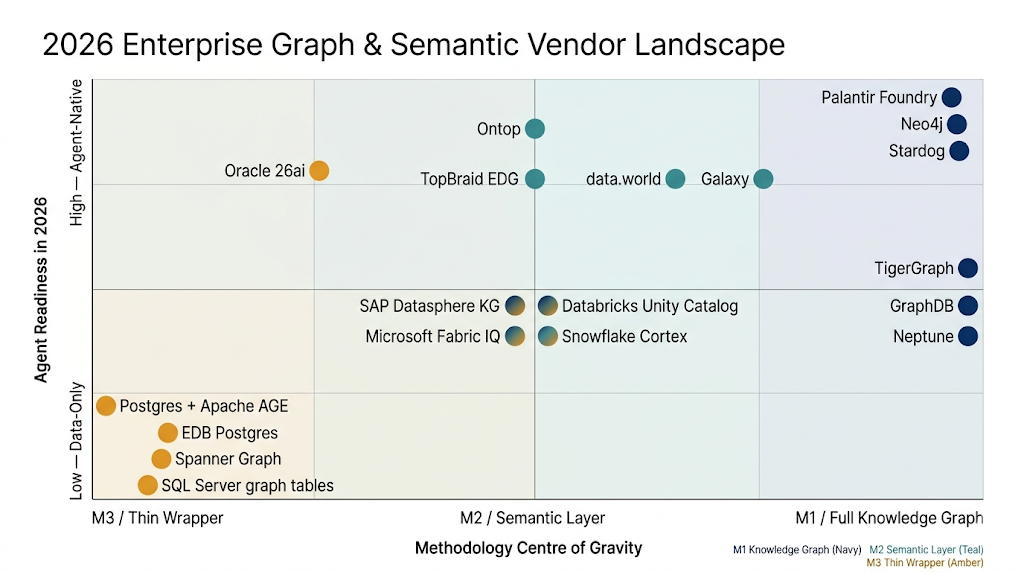
Pure M1 — Full Knowledge Graph specialists
- Neo4j — the most active vendor in 2026. Aura Agent (managed agent service), neo4j-labs agent-memory three-tier model (working / episodic / semantic memory for LLM agents), Context Graph for agentic workflows, providers for the Microsoft Agent Framework, and a benchmark showing a Neo4j semantic layer cutting Text-to-SQL token usage up to 10×. Roadmap focus: agentic GraphRAG with autonomous KG construction, on-device GraphRAG, NODES 2026's "Engineering Better Intelligence" cycle.
- TigerGraph — re-platformed onto Savanna (cloud-native, BYOC, separation of storage and compute, ~6× faster provisioning), added graph + vector hybrid search for fraud/AML/recommendation, released a Community Edition, and ships nine pre-configured solution kits (Transaction Fraud, Application Fraud, Customer 360, Entity Resolution KYC, Supply Chain, Network Infrastructure, etc.). Supports GSQL, OpenCypher, and ISO GQL.
- GraphDB by Ontotext — focus on RDF + OWL reasoning, deep semantic enrichment, strong in publishing, life sciences, and regulated industries.
- Amazon Neptune — Neptune Analytics, vector search, Bedrock integration for GraphRAG.
- Palantir Foundry Ontology — the most strategically positioned proprietary M1. 2026 launches include Ontology MCP (exposes the Foundry ontology to any external agent framework via the Model Context Protocol), AIP Agents, AIP Analyst (GA April 2026, NL interface that traverses the ontology with full transparency), and Copilot Studio integration that surfaces ontology data inside Teams and Outlook. The most aggressive "ontology-as-product" play in the market.
- AnzoGraph / Cambridge Semantics, Stardog (in materialised mode) — strong in regulated industries, government, defence.
M1 with strong M2 capability
- Stardog — the Voicebox product (LLM + KG agentic conversational layer over enterprise data, hallucination-free positioning) is the standout commercial GraphRAG play. Voicebox integrates with Teams and Slack, supports SMS/WhatsApp, and is positioned as a "dynamic fine-tuning layer for enterprise data." Stardog also runs in pure virtualisation mode (M2) across lakehouses, warehouses, and RDBMS without data movement, with up to 57× better price/performance claims on graph data virtualization.
- SAP Datasphere Knowledge Graph — embedded knowledge-graph engine inside Datasphere and HANA Cloud, anchoring the Joule copilot; SAP Business Data Cloud positioned the graph as the core semantic layer for SAP estates, with Databricks integration and ready-to-use Joule agents.
Pure M2 — Virtual Knowledge Graph / OBDA
- Ontop — open-source (Apache 2.0), the most mature VKG / OBDA engine; SPARQL-to-SQL rewriting, mature R2RML support, used in commercial deployments via Ontopic S.R.L.
- Mastro — commercial OBDA.
- TopBraid EDG / TopQuadrant — semantic governance plus virtualisation, strong in financial services and regulatory.
- Ontopic Studio — commercial layer on Ontop.
M2 with M1 fallback (hybrid)
- data.world — catalog + semantic layer + knowledge-graph-backed; positioned as the meaning layer over your existing data stack.
- Galaxy / Universal Metrics Gateway — launched Jan 2025, abstracts over multiple semantic stacks (Cube, dbt, Coalesce, AtScale) with auto-generated lineage and CDC-versioned metrics, ontology-driven KG with semantic layer.
- Anzo — hybrid posture, materialise-or-virtualise option.
Hybrid platform plays (positioning across all three)
- Microsoft Fabric IQ + OneLake — converging towards a unified semantic layer. OneLake Catalog Federation (preview) enables zero-copy access from Azure Databricks. Mirrored Unity Catalog tables are queryable via Power BI Direct Lake, semantic models, and Fabric-hosted GraphQL APIs. Roadmap discussion targeted at FabCon March 2026.
- Databricks Unity Catalog + Lakehouse IQ — Unity Catalog being positioned as an automatically-built technical ontology: certified tables, metric views, sample questions, FK graphs, and AI/BI Genie (NL-to-SQL) consume the ontology. Lakehouse Federation pulls Snowflake/Postgres/etc. into the same governance fence. Closer to M2 in spirit than to a true graph, but vendors will call it a knowledge graph.
- Snowflake Cortex — Semantic Views, Cortex Analyst semantic models, Cortex AI functions. Lighter on ontology, heavier on metrics/joins; effectively a semantic layer without graph reasoning.
Pure M3 — Thin Wrapper / SQL/PGQ
- Oracle AI Database 26ai (replaces 23ai as of the October 2025 release update; on-prem Linux x86-64 GA Jan 2026) — the first commercial SQL/PGQ implementation, deeply integrated with AI Vector Search (Unified Hybrid Vector Search), JSON Relational Duality, SQL Firewall. PGQL and SQL/PGQ both supported. The most enterprise-ready M3 platform in 2026.
- PostgreSQL + Apache AGE — open-source Cypher on Postgres tables.
- EDB Postgres + SQL/PGQ — EnterpriseDB's commercial implementation of the SQL:2023 standard on Postgres.
- Google Spanner Graph — graph queries over the existing Spanner cluster.
- Microsoft SQL Server graph tables — lighter-weight precursor, predates SQL/PGQ.
What "the centre of gravity" actually tells you
Most vendors will tell you they do all three. That's a sales surface. The realistic placement, in 2026:
- Pure M1 specialists with the deepest agentic roadmaps: Neo4j (agent memory + Context Graph), TigerGraph (Savanna + solution kits), Palantir Foundry (ontology-as-product via MCP).
- M1 vendors with credible Voice-of-LLM products: Stardog Voicebox (the only one shipping a fully agentic, hallucination-free conversational layer on top of an enterprise KG).
- M2 leaders: Ontop (open-source), Stardog (virtualisation mode), TopBraid EDG, Galaxy.
- M3 leader by a wide margin: Oracle 26ai. Postgres + AGE is the open-source default.
- Hyperscaler-native semantic plays moving into this territory: Microsoft Fabric IQ, Databricks Unity Catalog + Lakehouse IQ, Snowflake Cortex. None of these are full knowledge graphs; all are positioning to be the semantic layer your CIO has to evaluate alongside the pure-play vendors.
If a vendor refuses to tell you where their licence revenue comes from, that's the answer. Wherever the dollars sit is the methodology they actually do. The other two are marketing.
§ 05
How they actually differ (the table CIOs need)
| Dimension | M1 — Full KG | M2 — Semantic Layer + Virtual ABox | M3 — Thin Wrapper / SQL/PGQ |
|---|---|---|---|
| Where data lives | New graph store | Stays in source systems | Stays in source DB |
| Where meaning lives | In the graph (TBox + ABox) | In a formal ontology (TBox) external to data | Implicit in column / FK conventions, light labels |
| Reasoning / inference | Yes (OWL, SHACL, rules) | Yes (limited by mapping completeness) | Effectively no |
| Agent grounding fidelity | High (and doubles as agent memory) | High (the practical default) | Low (structure without meaning) |
| Query language | SPARQL / Cypher / GQL native | SPARQL rewritten to SQL | SQL/PGQ, Cypher-on-SQL |
| Latency on big joins | Fast (purpose-built indices) | Depends on source DB + rewrite quality | Source DB performance |
| Cost to stand up | High (ETL, modelling, new store) | Medium (ontology + mappings, no data movement) | Low (DDL + a property graph definition) |
| Cost to maintain | High (sync, drift, dual SoR) | Medium (mappings drift when schemas change) | Low (lives in the DB you already maintain) |
| Lock-in risk | High (proprietary graph stack) | Medium (ontology portable, engine swappable in OSS) | Low (it's just SQL) |
| Skills required | Graph engineers, ontologists | Ontologists + data engineers | Existing SQL team |
§ 06
Hybrid split architectures — the actual deliverable in 2026
No enterprise above mid-market is going to commit to a single methodology. The real architecture is a deliberate split where different domains sit at different levels, connected by a shared semantic spine. Here are the patterns that work, plus the ones that look clever and fail.
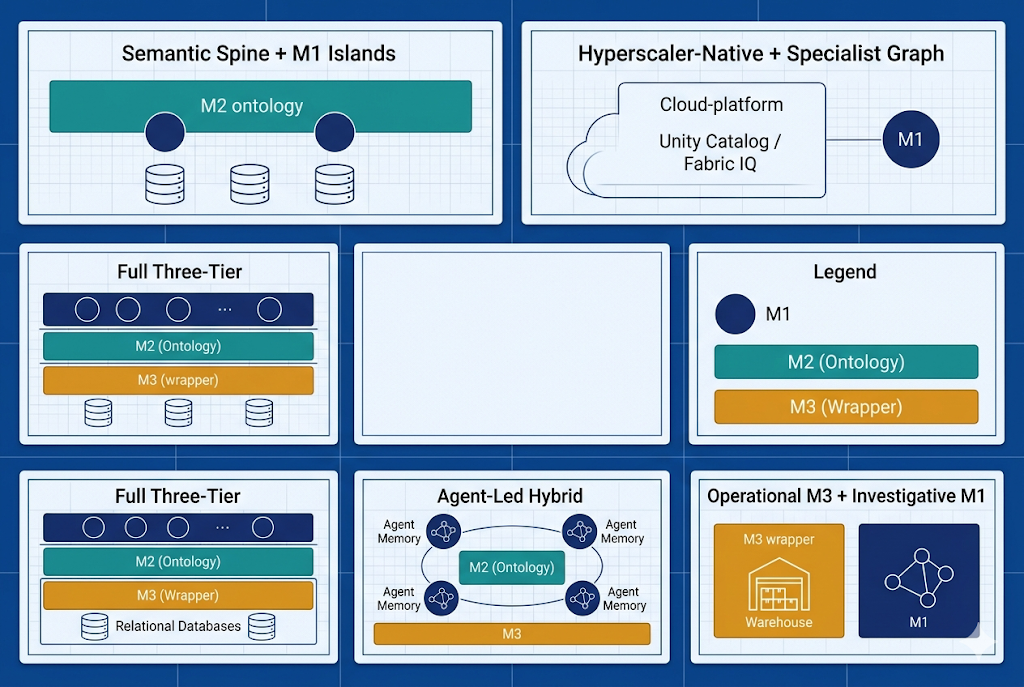
Pattern A — Semantic spine with materialised cores ("M2 + M1 islands")
Shape: M2 is the enterprise-wide ontology layer. Two or three specific domains are materialised into dedicated M1 graphs because they are graph-shaped and high-value.
Worked example — a bank:
- M2 over the warehouse, the core banking system, the CRM, and the policy DB.
- M1 islands for (a) financial-crime / AML investigation, (b) customer 360 + entity resolution.
- M3 under the warehouse for analyst self-service graph queries.
Why it works: the M2 ontology defines "Customer," "Account," "Transaction" once. The M1 AML graph projects only the entities and relationships needed for investigation, refreshed from the M2 mapping. Investigators get fast multi-hop traversal; analysts get governed warehouse access; agents get one grounded semantic layer.
Vendor mapping: Stardog (M2 spine + materialised mode for the islands), Palantir Foundry (whole stack in one product), or mixed — TopBraid EDG / Ontop for the M2 spine + Neo4j or TigerGraph for the M1 islands.
Where it fails: if the M1 islands diverge from the M2 ontology over time. Without strict mapping discipline, the islands drift, two definitions of "Customer" appear, and you are back to the problem you started with.
Pattern B — Hyperscaler-native + specialised graph ("Unity Catalog/Fabric IQ + M1 for the hard problem")
Shape: the platform-native semantic layer (Unity Catalog, Fabric IQ, Snowflake Cortex) carries the analytical and agent-grounding load over the warehouse/lakehouse. A specialist M1 graph handles the one or two domains where the platform's semantic layer is too thin.
Worked example — a retailer:
- Databricks Unity Catalog + Lakehouse IQ for product, sales, inventory, supplier analytics; AI/BI Genie for analyst questions.
- Neo4j as the M1 customer-knowledge-graph for personalisation, churn, journey analysis.
- M3 (SQL/PGQ on the lakehouse) for ad-hoc graph queries that don't justify Neo4j.
Why it works: you don't double-pay for a semantic layer that the hyperscaler is already shipping. Specialist graph spend is reserved for the workload it earns its keep on.
Where it fails: the hyperscaler's semantic layer is ontology-thin. If your governance team needs OWL/SHACL constraints, regulator-grade lineage, or cross-platform meaning portability, Unity Catalog and Fabric IQ are not enough. You will be forced to add an M2 layer on top, at which point the architecture becomes Pattern C anyway.
Pattern C — Full three-tier ("M1 + M2 + M3 by domain")
Shape: the most architecturally honest, also the most disciplined to maintain. Every domain is consciously placed at one of the three levels based on workload, with a shared ontology connecting them.
Worked example — an insurer:
- M3 layer: Oracle 26ai SQL/PGQ on policy admin, claims, and billing for operational graph queries (e.g. "all policies linked to this claimant through any household member").
- M2 layer: Ontop or Stardog virtualisation over policy admin, claims, billing, broker, and reinsurance systems — the ontology defines Policy, Claim, Insured, Coverage, Peril, Exclusion. Agents and underwriting copilots ground here.
- M1 layer: dedicated Neo4j or TigerGraph for (a) fraud ring detection on claims, (b) reinsurance treaty modelling.
Each layer has a clear owner, a clear workload, and a clear cost basis. The M2 ontology is the binding contract.
Why it works: workloads matched to the right substrate. Cost proportional to value per domain.
Where it fails: without a dedicated ontology team owning the M2 layer, the three levels diverge and the architecture becomes three uncoordinated silos with overlapping definitions. The most common failure mode in practice and the reason most enterprises end up at Pattern A or Pattern B instead.
Pattern D — Operational M3 + Investigative M1 (no M2)
Shape: M3 for analytical and copilot workloads on the warehouse; M1 for one investigative domain; no enterprise ontology layer.
Worked example — a mid-market bank:
- Postgres + AGE / Oracle 26ai SQL/PGQ for analyst and copilot graph queries.
- Neo4j for AML/financial-crime investigation only.
Why it works for mid-market: you may not have the headcount to run an ontology programme. Skipping M2 is a conscious cost-cutting decision. The M1 graph for AML stands alone because regulators force its existence anyway.
Where it fails: at scale. As soon as you have more than one domain that wants an M1 (say, fraud and customer 360), the absence of a unifying M2 ontology means each M1 reinvents the entity model. Eventually you pay for M2 in pain.
Pattern E — Agent-led hybrid ("ontology + memory graphs")
Shape: emerging in 2026, especially in shops betting heavily on Neo4j or Palantir. The M2 ontology grounds what the enterprise knows. A separate, smaller M1 graph per agent (or per agent family) holds what the agent has learned and done — episodic memory, task chains, learned associations.
Worked example — a managed-services firm:
- M2 over the ticketing system, CMDB, customer contracts, knowledge base.
- Per-agent M1 memory graphs (Neo4j) holding case history, successful resolution paths, learned shortcuts.
- M3 (SQL/PGQ on the operational DBs) underneath for live operational queries the agent issues.
Why it works: separates what the company knows (long-lived, governed, M2) from what the agent remembers (high-churn, per-agent, M1). Lets you scale agent memory independently of the enterprise ontology.
Where it fails: if the agent memory graphs are allowed to override the M2 ontology when they disagree. Agent memory must always defer to the governed ontology, not the other way around. Vendors are still figuring this out — Neo4j's agent-memory three-tier model is the most credible attempt so far.
Patterns that look clever and fail
- M3 + M1, no M2. "We'll use SQL/PGQ for analytics and Neo4j for the hard problems, and skip the ontology layer." Six months in, every domain has its own definition of Customer. Twelve months in, the agents are confused. Either commit to building M2, or stay single-tier.
- Three separate M1 graphs, no M2. "We'll have a fraud graph, a customer graph, and a supply-chain graph, and integrate them later." They never integrate. Each becomes its own silo with its own ontology team.
- M2 over six sources with no M3 underneath. Federated SPARQL across six live operational systems will collapse under any non-trivial join. M2 over a warehouse is fine; M2 over a half-dozen OLTPs without a query-acceleration layer is not.
- Hyperscaler semantic layer as a substitute for a real ontology. Unity Catalog and Fabric IQ are excellent for analytical consistency. They are not OWL. If your regulator needs to see formal semantics, you still need M2.
Choosing your hybrid — two practical heuristics
- Count your true graph-shaped domains. If it's one, you're in Pattern D. If it's two or three, Pattern A. If it's four or more, Pattern C with a serious M2 team.
- Count your data platforms. If 80% of your data is in one hyperscaler stack, Pattern B is the cheapest path. If you have a genuinely multi-vendor estate (Oracle + SAP + Salesforce + a lake), Pattern A or C is mandatory; the hyperscaler-native layers won't span it.
The agent overlay on top of any pattern
Whatever hybrid you pick, in 2026 you also need to decide:
- Where does agent memory live? In the M1 (Pattern E), in a dedicated memory store alongside the M2, or in the platform (Foundry, Stardog Voicebox)?
- How are agents grounded? Via MCP exposure of the M2 ontology (Palantir's model), via direct graph queries to the M1 (Neo4j's model), or via the platform's own grounding (Foundry, Voicebox)?
- What is the audit trail? Every agent action should resolve back to either an M2 concept or an M1 entity. If it resolves only to an M3 row, you have no semantic explanation of what the agent did.
The hybrid is not optional once agents are in the picture. The question is whether you design it consciously or end up with one accidentally.
§ 07
Where each methodology fits (workload by workload)
M1 (Full KG) is the right answer when…
- Relationships ARE the product. Fraud rings, AML, anti-trust litigation, supply-chain provenance, drug discovery, intelligence analysis, identity resolution across hundreds of sources.
- You need deep multi-hop reasoning (5+ hops with cycles) where SQL recursive CTEs collapse.
- You need OWL/SHACL reasoning — inferring new facts, validating compliance against logical constraints, propagating subclass/equivalence axioms.
- You're building a long-lived enterprise ontology product that BI, agents, RAG, search, and regulators will all hit.
- Master data and entity resolution at scale — a graph is the natural way to hold "these 17 records across 9 systems are the same customer."
- Investigative or R&D agents need a substrate for both reasoning and memory.
M2 (Semantic Layer + Virtual ABox) is the right answer when…
- You have many heterogeneous sources (warehouses + lakehouses + operational DBs + SaaS) and need one business-meaning layer over them, without an 18-month ETL programme.
- Source data changes faster than you can re-ingest. Live operational systems, IoT, financial transactions — query-time freshness beats nightly graph rebuilds.
- Governance is non-negotiable. A formal ontology gives you explicit semantics, lineage, access policies, and reasoning, without duplicating every transactional record.
- You are building any agent workload of consequence. M2 is the minimum viable grounding layer for customer-facing, financial, or regulatory agents.
- You have a 5–7 year horizon and want the option to materialise later. M2 is the only methodology that can be incrementally converted to M1 or downgraded to M3 without ripping out the meaning layer.
This is the architecturally honest answer for most large enterprises in 2026.
M3 (Thin Wrapper) is the right answer when…
- Your data is already in one or two modern relational platforms — Oracle 26ai, Postgres, Spanner, SQL Server — and the team's centre of gravity is SQL.
- The graph workload is analytical, not reasoning-heavy: shortest path, pattern matching, fraud detection rules, network analysis, recommendation traversals.
- You don't need a portable, vendor-neutral ontology. Meaning lives in conventions and documentation, not in OWL.
- You want the lowest possible TCO and zero data movement.
- You're running a 6–12 week pilot to prove graph value before deciding whether to invest in M2 or M1.
- You have no agent workload, or only a single-source NL-to-SQL copilot grounded by the warehouse's own semantic layer.
§ 08
Where each one fails — the honest take
M1 fails when…
- The graph becomes a second source of truth. ETL drift, sync lag, and dual-write inconsistencies destroy trust within 18 months.
- The ontology is owned by a central team of two people who become a permanent bottleneck. Every new use case waits in their queue.
- Source schemas change weekly. The graph is always 3 sprints behind reality.
- Latency-sensitive operational queries are forced into the graph and the graph store can't keep up under load.
- The business case rests on "we'll have a single 360 view" — 90% of these projects deliver a partial 360 of one domain after 24 months and quietly de-scope.
- You picked an expensive proprietary graph DB for what turns out to be light pattern-matching workloads. You'll pay a 5–10× premium versus M3 for capabilities you never use.
M2 fails when…
- The source systems can't handle the federated query load. SPARQL-to-SQL rewriting can generate brutal SQL plans across joined sources; legacy systems collapse.
- Mappings rot. Every schema change in CRM, ERP, billing breaks an R2RML mapping. Without strong mapping-ops discipline, the layer silently lies.
- Latency expectations are real-time (sub-100 ms). Query-time federation rarely meets this.
- The team builds the ontology in academic isolation — ontologists model an abstract OWL view of the business that no one downstream can use or query.
- Cross-source joins are too deep. Federating a 7-way join across a Postgres OLTP, a Snowflake warehouse, a Mongo store, and a SaaS API will not return in time, regardless of how good the engine is.
- OWL reasoning is enabled naïvely. Full materialisation of inferred triples at query-time blows up.
M3 fails when…
- You need actual reasoning. SQL/PGQ does pattern matching, not OWL. No subclass inference, no constraint validation, no logical equivalence.
- The graph spans multiple databases. SQL/PGQ today is single-database. Cross-DB graph queries are not what this methodology is for.
- You expected portability. Cypher-on-Postgres, SQL/PGQ on Oracle, and AGE syntax are not interchangeable. Lock-in is medium even though the data is open.
- The business needs a shared, governed semantic model. Labels and FK conventions are not a semantic layer. Two business units will define "Customer" differently and you'll never reconcile it inside SQL.
- You scaled it to enterprise-wide ontology duty. It collapses; it was never designed for it.
- Agents / LLMs need ontology-aware grounding. A property graph view of tables gives them structure but not meaning. You'll bolt on M2 or M1 later, and the M3 work doesn't carry forward.
§ 09
Decision logic — in language a CIO actually uses
Most enterprise architecture docs ask this in a way that doesn't survive contact with reality. "Is meaning a business deliverable?" is the kind of phrase that loses the room. So here it is in plain English.
Question 1 — Are agents on your roadmap in the next 18 months?
This now comes first because the answer reshapes everything.
- Yes, and they will touch customer, financial, or regulatory data → you cannot stop at M3. The minimum is M2 for grounding; you may also need M1 islands for agent memory in high-stakes domains. Skip to Q3.
- Yes, but only an internal NL-to-SQL copilot grounded by the warehouse's own semantic layer → M3 + the hyperscaler's semantic layer may be enough. Pattern B.
- No agent ambitions, or only experimental → continue to Q2 in the original (data-only) framing.
Question 2 — Will the business pay someone whose only job is to define what your data means?
This is the real test for the meaning layer. Some enterprises have, or will hire, an ontology team / semantic data team / business glossary owner / chief data architect whose deliverable is the agreed meaning of business concepts — what counts as a "Customer," what makes an "Active Account," how "Revenue" is defined across regions, which products are subsidiary to which brand. That deliverable lives somewhere — Confluence, a glossary tool, a catalog, or, increasingly, in a formal ontology.
- Yes → you're already paying for meaning. M1 or M2 will give that team a place to put their work where machines can use it. Continue.
- No — definitions are owned ad hoc by whoever runs the report, and the answer to "what is a Customer?" is "depends who you ask" — then you cannot sustain M1 or M2. The ontology will rot in six months. M3 is your honest choice. You'll get graph queries on your existing tables and call it a day. (If you also answered "yes" to Q1, you have a contradiction — go hire the ontologist before you ship the agent.)
Question 3 — Are the connections between things what you are trying to find, or are the things themselves?
- Connections are the answer: "Who is connected to whom through which accounts and which transactions?" "Which suppliers feed which factories that ship to which customers?" "Which compounds interact with which proteins in which trials?" → M1. This is where graph databases earn their keep.
- Things are the answer, and connections are how you join them: "Show me revenue by region and product, joined across CRM, ERP, and billing." "Give the AI agent the context it needs to answer customer questions across our systems." → M2. You don't need a separate graph store; you need one consistent meaning layer over what you already have.
- Things are the answer, connections are nice-to-have, and the data is already in your warehouse: → M3. Just give SQL the graph operators and move on.
Question 4 — Can you afford a second copy of your data?
A full knowledge graph means physically extracting data into a new store. That implies pipelines, sync logic, dual ownership, drift management, an SRE rota for the graph store, and the inevitable "which one is right when they disagree" conversation.
- You can afford it, and the domain is worth it (fraud, intel, MDM, regulated provenance, agent memory for a high-stakes domain) → M1.
- You cannot, or the domain isn't worth a dedicated graph SRE team → M2 (data stays put, ontology gives you meaning) or M3 (no ontology, no data movement, lowest cost).
Question 5 — What does your data actually live in today?
- One or two modern relational platforms (Oracle 26ai, Postgres, Spanner, SQL Server) and you're not doing OWL reasoning → M3 is the most honest, fastest, cheapest answer for the analytical layer. Pilot it in six weeks. Put M2 above it if Q1 or Q2 demanded it.
- Five+ heterogeneous sources (warehouses, lakehouses, OLTPs, SaaS) → don't try to force M3. You need M2 (or eventually M1) to span them.
Question 6 — What's your honest five-year horizon?
- You're not sure what AI agents will need from your data in 3 years → start at M3 to prove the analytical workload, build M2 in parallel as the governed semantic asset, and reserve M1 for the two or three domains where the graph genuinely IS the system of record. This is the most reversible path.
- You already know AI is core to a regulated, high-stakes domain (financial crime, drug discovery, defence, life sciences) → commit to M1 in that domain with M2 around it for everything else.
The CIO's one-line version
If your enterprise has agents on the roadmap and treats data definitions as a real, owned deliverable, you need a meaning layer (M2 minimum, M1 if relationships are the product or agent memory needs structure). If it doesn't, you need graph queries on the tables you have (M3). Don't buy the ontology before you've hired the ontologist — and don't ship the agent before you've bought the ontology.
§ 010
Takeaway for enterprise heads
The industry markets all three as "knowledge graph." They are not the same thing. And in 2026, you are no longer choosing one of them — you are designing a stacked context architecture.
- M1 (Full Knowledge Graph) is for organisations where relationships are the product — fraud, MDM, intel, R&D, regulated lineage — or where high-stakes agents need a structured memory substrate. High value, high cost, high lock-in. The most active vendors in 2026 are Neo4j (agent memory, Aura Agent, Context Graph), TigerGraph (Savanna + hybrid vector + solution kits), Stardog (Voicebox is the standout GraphRAG product), GraphDB, Neptune, and Palantir Foundry (Ontology MCP + AIP Analyst is the most aggressive ontology-as-product play in the market).
- M2 (Semantic Layer + Virtual ABox) is the architecturally correct default for most large enterprises in 2026 — and the minimum viable grounding layer for any agent of consequence. Separates meaning from storage, avoids ETL sprawl, keeps source-of-truth where it belongs, gives you a portable ontology asset. Ontop (open source), Stardog (commercial, with Voicebox as the consumption layer), and TopBraid EDG are the credible starting points. The hyperscaler-native versions — Microsoft Fabric IQ, Databricks Unity Catalog + Lakehouse IQ, Snowflake Cortex — are converging on the same posture but with weaker ontology fidelity and stronger platform lock-in.
- M3 (Thin Wrapper / SQL/PGQ) is underrated and quietly solves 60–70% of the analytical "we want a knowledge graph" use cases. Oracle AI Database 26ai is the most production-ready M3 platform; Postgres + Apache AGE, EDB Postgres, and Spanner Graph are credible alternatives. If your data lives there and you don't need OWL reasoning or rich agent grounding, this is a 6-week deliverable, not an 18-month programme.
The honest sequencing for most enterprises:
Start with M3 to validate the analytical workload. Build M2 in parallel as the governed semantic asset, only if you have or will hire someone whose job is to own the meaning, and required if you have agents of consequence on the roadmap. Reserve M1 for the two or three domains where the graph genuinely is the system of record — fraud, MDM, regulatory provenance, or high-stakes agent memory.
The five wrong moves
- Start with M1 because a vendor convinced you that's what "AI-ready" looks like. It's the most expensive, slowest, and most lock-in-heavy path — and for most enterprises, it solves a problem they don't yet have.
- Dismiss M2 because "we already have a data fabric." A data fabric is plumbing. A semantic layer with a virtual ABox is meaning. Different layers of the same stack; they don't substitute for each other.
- Assume M3 is "just SQL with extra steps." In 2026, with Oracle 26ai shipping SQL/PGQ in production and Postgres+AGE mature, M3 is genuinely a different shape of query that solves a real class of problems — inside a licence you've already paid for.
- Ship agents on M3 alone. You will get away with it on the demo. You will not get away with it on the third customer-facing incident.
- Build three M1 graphs and skip M2. Each becomes a silo with its own definition of Customer. The integration project you defer is the integration project you will eventually pay double for.
The CIO's 2026 action list
- Decide which domains earn an M1 island — usually 1–3, including fraud/AML/MDM and the highest-stakes agent domain.
- Decide whether your meaning layer is the hyperscaler's (cheap, locked-in, weak ontology) or a real M2 (Stardog, Ontop, TopBraid — portable, ontology-grade).
- Confirm M3 capability inside your primary database (Oracle 26ai, Postgres + AGE, Spanner) for the long tail of analytical graph queries.
- Decide where agent memory lives, and who owns it — in the M1, in a dedicated store, or in the platform.
- Hire the ontologist before signing the M1 contract — or accept that you are buying Pattern D and stay there honestly.
The hybrid is the deliverable. Design it consciously, or end up with one accidentally.